Make DORA operational, not episodic
- Reduce late-stage fixes by making decision thresholds and ownership explicit
- Keep the RoI and dependency evidence accurate and up to date
- Make testing and incident learning measurable, not narrative
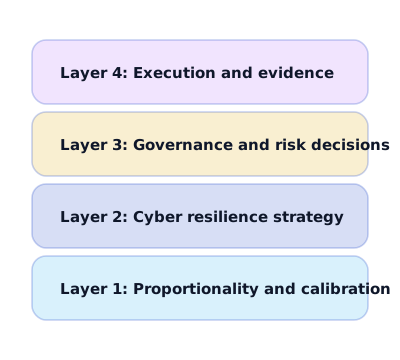
Sustainable DORA is continuous resilience
The five pillars helped to reach the deadline. Sustainability requires an operating model that remains effective.
Sustainable DORA connects proportionality, strategy, governance decisions, and execution evidence into one operating model that remains effective under change and disruption.
DORA in five pillars
Building an operating model
Lower layers enable the layers above. Without the foundations, execution becomes escalations and evidence rebuilds.
Layer 1: Proportionality and calibration
Define how thresholds, testing depth, evidence expectations, and escalation paths scale with criticality and impact.
- Keep effort proportionate to impact and criticality
- Avoid bureaucracy by calibrating governance rather than applying one global standard
More on this: Security Governance & Operating Models.
Layer 2: Cyber resilience strategy
Clarify what must remain reliable and where investment should be concentrated.
- Anchor priorities in business criticality and realistic disruption scenarios
- Connect strategy to dependency exposure and operational fragility
More on this: Operational & Cyber Resilience.
Layer 3: Governance and risk decisions
Make intent actionable: ownership, KRIs, thresholds, escalation, and tested capability.
- Translate policy intent into decisions and accountability
- Use decision-grade indicators to steer risk, not just review it
More on this: Security Governance & Operating Models.
Layer 4: Execution and evidence
Make the operating model observable in day-to-day execution and evidence.
- Incident management that produces learning
- RoI maintained as a dependency dataset
More on this: Third-Party Oversight, Resilience Engineering, and Resilience Transformation & Delivery.
The Register of Information (RoI)
Treating the RoI as a reporting output creates recurring data quality, ownership, and validation failures.
A practical starting point
Validate the DORA Register of Information for structural issues early, before submission.
The DORA RoI Health Check is a browser-based validation tool. All data stays in the browser and results are available instantly.
Related insights
Beyond the first submission: three governance failures that will break your DORA RoI in 2026
The 2025 Register of Information submission was a scramble for most organizations. In 2026, the biggest challenge many organizations still face is unresolved governance, driven by unclear ownership, disconnected …
Why your DORA Register of Information looks complete but fails regulatory validation
The Register of Information often looks complete during internal preparation but fails regulatory validation. This happens because the reporting templates do not enforce the underlying data model. This post explains what …
The DORA Register of Information is a Data Problem, Not a Compliance Problem
The Register of Information is creating confusion across the industry. But the difficulty is not DORA itself. The EBA published a structured information model with entities, relationships, and integrity constraints. It …
Is your DORA programme becoming a reporting project?
If delivery is stuck in coordination and late-stage fixes, DORA becomes episodic. This engagement focuses on an operating model that stays continuously effective.